Tuesday, 14 September 2010

Change the title Elizabeth Burton-Smith: what my family did on drugs

There is no doubt this is an authentic and heartfelt book. It comes with much high praise, from no less a source than our former PM Gordon Brown and current home secretary, Theresa May. Anyone aware of the inadequacies of the Misuse of Drugs act will begin to hear alarm bells ringing as soon as they have read such endorsements. For how could such members of the establishment ever endorse a book that is then critical of prohibition?

The obvious answer is that they wouldn’t. Not that this should detract from this book. No, the book in many ways condemns itself. This is a story of one family’s tragic loss of one of its members to drug addiction, whilst the surviving twin is a recovering heroin addict.

Time and again the narrative by the family’s mother, Elizabeth Burton-Phillips wastes no opportunity to warn of the dangers of drugs and to tell the reader drugs are evil. In many ways this is conventional fare and herein is the problem. Alternatives to current drug policy are not on the agenda in this book.

Here it is worth taking a further look at the book’s title. Mum Can You Lend Me Twenty Quid: What Drugs Did to My Family. And there you have it. This is a story of what the drugs did. This reviewer is certain that this family has suffered during the period of time its’ sons were addicted to heroin. But what follows in the narrative is that the blame lays at the door of drugs, and what drugs did to my family. Yet it never asks if an alternative future for Burton-Phillips sons could have been had under a regime that regulated and controlled drugs, rather than leaving this to criminal gangs.

It does not take a person with a cold heart to adapt the subtitle and question whether it should read: What my family did on drugs. Not when you consider that parents that have lost their children to drugs, but want to see the back of the Misuse of Drugs Act, face a much harder time in getting their voices heard by an unsympathetic media. Indeed, it would be interesting to see former Prime Ministers and current Home Secretaries address their concerns once in a while.

Thursday, 9 September 2010

Beer !


Recently LBR found himself in the envious position of having either no beer, or resorting to supping American beverages. Now, LBR has always been hesitant to take on American beer. Any country that has experienced prohibition could not possibly provide beer worthy of the name to this Euro-trash ale enthusiast. Indeed Peter Carey wrote about drinking an American beer: "What a jar of cat's piss that turned out to be." (Butcher, in the book Theft, p199)

Never let it be said that LBR clings to an opinion despite all evidence to the contrary. Given the choice between no beer, and American beer, the latter wins. In fact American beer is pretty decent stuff.

Wednesday, 8 September 2010

The Millenium Trilogy: The Girl Who Plays with Fire and The Girl Who Kicked the Hornets Nest by Stieg Larsson


Quite simply - forget my previous reservations and believe the hype. The whole series has entered into my favorite top five fiction books of all time.

The whole Millenium Trilogy gets 5/5.

Counting the cost: the end of the review

Helen Dunmore’s ‘Counting the Stars’
In the early part of this century, a couple of friends recommended The Siege by Helen Dunmore to me. Not all word of mouth recommendations satisfy, but on this occasion LBR was pleased. Later in the century LBR had cause to encounter Robert Harris’s excellent ancient Roman novels Pompeii and Imperium.

It would therefore be safe to assume that with Dunmore having produced a Roman novel, it too would receive the LBR thumbs up. Alas no. Dunmore’s book Counting the Stars is a staggeringly dull piece of work. It isn’t badly written, but lacks sufficient interest for the reader to care for the characters. Without this the constant the question that came to mind was; what is this book for? Until a moment ago, LBR had struggled to search for an answer.

LBR has clearly suffered for Dunmore’s art, but does not expect its readers too as well. This had led to a radical editorial decision so that some good can come from having read such a turgid piece of dullness. This column will continue to highlight to its readers any strikingly good piece of art that it comes across. Or even a bad piece from which discussion of interest can be had.

However, dull pieces of trash, or just mediocre, should not have to be revisited by the reviewer. Reading it is bad enough. But having to work on a review is even more time that cannot be got back. This book would have got 1/5.

Friday, 9 July 2010

A day in Preston Station


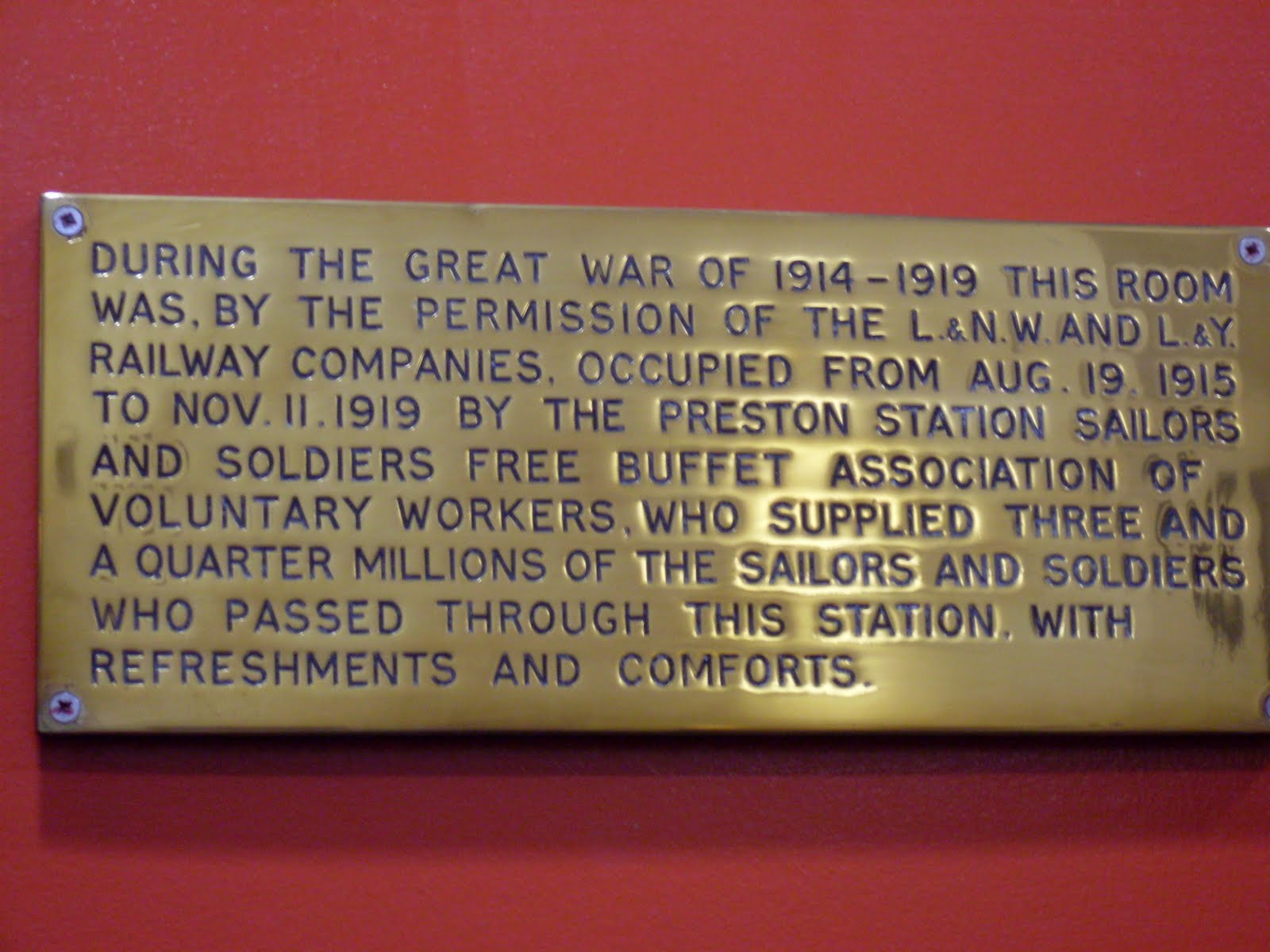
On a long journey through England, waiting for a train in a waiting room I saw these signs. Just proving to me that History is alive, well and still with us.

"The Gamble" by Thomas E. Ricks


In terms of quality and tone this book picks up where the previous book, 'Fiasco' left off. Ricks still ends on a pessimistic note. For example, Iraq is more likely to closely recognise Lebanon, rather than a Western democracy (p317). As such this review has little to add, and possibly the reviews should have been done at the same time. Except, Ricks add an important element to this book that could not be raised in the first; the possibility of victory. Victory did not look likely during the time of 'Fiasco'. 'The Gamble' quite literally gives victory a chance.

Ricks also convincingly argues that victory will not look and feel like the victory that Western democracies are used to seeing. 'Victory' and 'success' will be highly debateable terms in this conflict. Indeed this maybe as a direct result of the nature of the conflict. Insurgencies do not lend themselves to clear cut victories.

It is worth quoting Ricks at length in terms of his view on the likelihood of victory in Iraq:

P316 “Nor, at the end of many more years of struggle, is the outcome likely to be something Americans will recognise as victory. Instead these additional years of sacrifice promise to be made for markedly limited objectives. A senior intelligence officer in Iraq described the long term American goal as ‘a stable Iraq that is unified, at peace with its neighbours, and is able to police its internal affairs, so it isn’t a sanctuary for al Qaeda. Preferably a friend to us, but it doesn’t have to be.’ He paused then pointed noted that his list doesn’t include democracy or the observation of human rights.
That is a surprisingly common view among officials in Iraq, even if it hasn’t yet sunk in with many Americans. Few foreigners are as steeped in Iraqi issues as Emma Sky, who is now on her third tour in the country. ‘The idea that you bring democracy to Iraq and they all become secular, liberal supporters of Israel – well, there are a lot of scenarios I can imagine before that one,’ she said. ‘It’s not going to end that way.’”

P331 “Among those that still talks of an American ‘victory’ in Iraq should be asked to address this question: For many years to come, the government in Baghdad is not likely to be stable or very democratic, but almost certainly it will be closer to Tehran than Washington. What part of that constitutes success for the US government?”

Monday, 5 July 2010

The War on Drugs: it's worse than we thought

LBR was always under the impression that prohibition cost the UK £14bn a year. This figure comes from the pressure group Transform. But not according to the House of Lords. That bastion of radicalism have said the cost is actually £19bn. Every year.

Whilst Labour have elected a new leader (just announced) and the Con-Dems work on a spending review, the cost of keeping drugs illegal are not the agenda.

If you do not trust this column - then ask the House of Lords.
http://news.bbc.co.uk/democracylive/hi/house_of_lords/newsid_8735000/8735625.stm

Why Cooper Should have run: Women matter

With Ed Miliband just being announced leader of the Labour party I can't help thinking that not having a more credible woman candidate than Diane Abbott was a loss. Churlish some may say to suggest, but there you go.

It is a real shame Yvette Cooper didnt run. Intelligent and bright, she would have been a real asset. Especially if women will be at the forefront of the Con-Dem cuts.

Good luck to Ed Miliband. He will need it. But LBR urges caution. Nobody voted Tory at the last election to see a more left wing Labour party.


http://www.guardian.co.uk/politics/2010/jul/04/women-budget-cuts-yvette-cooper

Thursday, 1 July 2010

"Coma" by Alex Garland


Like his more successful book, The Beach, Coma has short, punchy chapters. No page numbers though. But that doesn’t matter as it an exceptionally short book and takes less than a day to read. The plot is well written and has some interesting illustrations. (The images clearly signify something, but I have not figured out what that is yet.)

So to the plot; Carl is in a coma after a nasty late night incident on the underground. What drives the plot is not any mystery surrounding his story or any connection to the assault which results him being in a coma. Rather it is the process through which Carl deals with being in a coma and his attempt to wake up.

Reading this novel reminds one of the Spanish film “Open your eyes” and The Jam’s song, “Down in a tube station at midnight.” Not sure Garland does anything with this story to justify the price tag of the book, especially as it is very short, but it is entertaining enough. Furthermore, Garland has the ability to make brilliant insights and write them well: to whit “Waking was the most reliable part of a dream, as built into dreams as death into life.” This book gets a generous 3/5.

"The remains of the day" by Kazou Ishiguro


A serious work about a conscientious butler looking back on his working life would not appear to set the pulse racing. Yet Ishiguro beautifully captures the voice of Mr Stevens, the protagonist, as he describes the suffocating life the butler has imposed on himself as he attempts to do his work with dignity.

In addition some of the great foreign policy events of the 20th Century are integral to the story, which gives the plot depth. Set in 1956, a year in which Britain is also forced to consider her role in the world due to the Suez crisis.

Considered by some to be a contemporary classic, the plot is less than pacy, but this reflects the suffocating atmosphere of 1950s England, and there are moments of real comedy. This book gets 3/5.